Youth Worship

~ by Jessica Thompson

This past weekend I had the great privilege of leading worship at Glengate’s annual youth retreat. Every year, it ceases to amaze me how God uses worship to speak to the young people who attend the retreat. God continues to show me the power that music has to penetrate our hearts and create a forum to speak freely and honestly to him.

Together with the other members of the worship team, we chose a collection of songs that represented traditional youth favourites, songs that reflected the messages of the weekend and a couple brand new ones that we hoped would become the songs our youth would quietly hum and sing on the car ride home; a chant they would use as a reminder of the weekend. Jordan McCourt and I prayed over these songs and decided on one named “We Won’t Be Shaken” by Building 429. The chorus goes as follows:

“Whatever will come our way
Through fire or pouring rain
We won’t be shaken, we won’t be shaken
Whatever tomorrow brings
Together we’ll rise and sing
We won’t be shaken, no we won’t be shaken”

During our third and final worship set, this song came on and I remember stepping back from the microphone, closing my eyes and hearing the vibrant, bold voices of the many youth in the room singing in unison “We won’t be shaken, no we won’t be shaken!” This song that God had placed on the hearts of the worship team had become this beautiful testimony of the weekend. It served as a reminder that this world is not our home and that through the many trials that we will face in life, we must stand firm, refusing to be shaken. In that moment, we were united as one entity, praising our heavenly father and committing to standing firm. It was both amazing and humbling.

Music may come in all styles, but worship transcends them all. I know that at that moment, God was looking down at his children, listening to them sing as one, and was very pleased. And that moment will forever serve as a reminder for me to remember that whatever I am going through, God is bigger. When difficult times arise, I am not alone. I will rise and sing with my brothers and sisters “we won’t be shaken” and remember the love and power of my God Almighty. 
True Worship

~ by Adam Ane

When I first came to Glengate, I already had a background in music and had been to countless shows in Toronto and other places. What I really appreciated most about the worship at Glengate was that the songs that I had recently come to know were being played and sung- but the weren't done like I had heard from the artists. I really appreciated that because what I heard was people worshipping the only way they knew how. And that was the way God had built them. I got to see people in true worship. In front of their family, and as they worshipped the family also worshipped and it wasn't a performance like I was used to . It was a family of believers worshipping: some on the stage and some in the chairs in the gym. That is what I appreciated. There was no pretension, no 'performance', no ego, and to me it seemed more real than some of the other church places I had been that seemed to be all caught up in 'performance' and lights. And coming from that background for many years prior- it was the last thing I wanted to see. It's not that doing those kinds of things are wrong but if it becomes the driving force then I think we've lost something.


Dead Air

~ by Heather and Clara Birch

Absolute silence in a worship service can be desirable, if it is planned or if it results in worshipful contemplation or reflection. However, if periods of silence are due to the worship team shuffling their music or a speaker walking to the podium, these silences are not valuable, and can distract worshippers. We are not advocating for busy or rushed worship services, but for the worship team members to take responsibility for minimizing potential distractions.
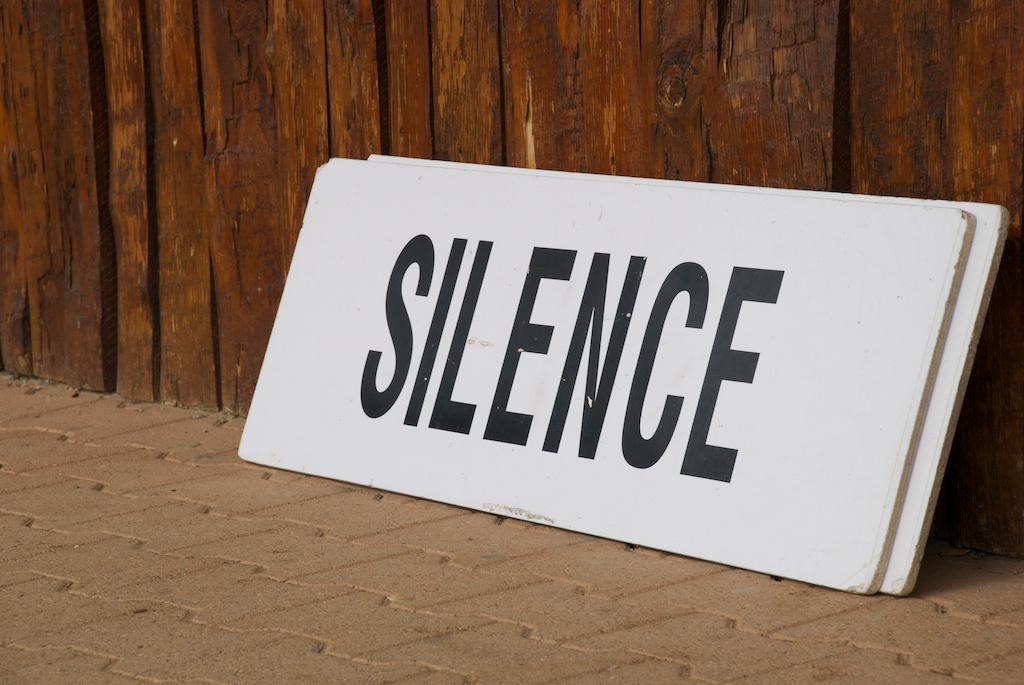
Sign which says Silence sitting on floor We propose two ways in which our worship team can minimize undesirable silence, or, “dead air.” First, when a worship set is coming to an end, the worship leader can give a small nod to the speaker who is up next. Then the speaker is prepared to walk up to the podium on time, reaching it as the music ends. Second, the worship team can make an effort to minimize dead air between any two worship songs. This can be done by
  • playing worship sets which feature songs in a single key and time signature, and playing them without stopping in between,
  • being prepared after each song to quickly begin the next one, within 1-2 seconds, or
  • practicing musical transitions which can effectively link worship songs together.
While we try to link worship songs together as often as possible, admittedly, it doesn't always work perfectly. Poorly executed transitions which sound abrupt or awkward, or cause the congregation to become confused about when to come in are unfortunate. However, this is not a reason to declare that musical transitions are inappropriate or undesirable, but a sign that we need more practice, or that the transition needs adjusting.
It is possible to move between songs of different keys, without stopping, by playing a chord progression (series of chords) which leads you from one key to another. This is known as modulation.  

Tools

  • Tim Bergmann has created a tool called The Modex, which he advocates as “an effective tool for creating musical bridges.” An old-school version of The Modex, which is made of paper and a plastic spinner, is in the Worship Room for your use. There is also an iPhone app ($1.99) called “Musician's Toolbox,” which contains The Modex, as well as a transposing tool and a tuner. When you indicate any two keys to The Modex, it provides 7 different sets of chords you can use to move between those two keys. I highly recommend buying this app if you have an apple phone!
  • A tutorial explaining how to write modulations between keys is also available on this site.

Transitions Tutorial

- by Heather Birch

See a post about why transitions are important. Use the charts below to determine chord progressions which can be used between songs of different keys, to create smooth transitions, or modulations.


Step 1
Decide which key you are starting in (Original Key). 


Step 2
Decide which key you are moving to (Destination Key). 


Step 3
Figure out the distance between the Original Key and the Destination Key by counting the number of semitones the two keys are apart, on the keyboard. A semitone is the distance between one note and the very next note, black or white. When counting the distance between two keys, do not count the first key. For example, if your two keys are C and F, do not count C. Count C#, D, D#, E, and F. Therefore, the distance between C and F is 5 semitones. Other examples: The distance between Aflat and D is 6 semitones. The distance between F and G is 2 semitones.

Picture by: piano-keyboard-guide.com
Step 4
Look at the row in the chart below which corresponds to the distance you are moving from key to key. Write down the roman numerals for the set of chords (chord progression) you will be working with. 


Example 1

I'm moving up 5 semitones. Therefore, my transition chord progression will be:   
I I   I7sus  I7  IV

Example 2

I'm moving up 10 semitones. Therefore, my transition chord progression will be:
I I7sus flatIII/IV  IV7 flatVII 

Step 5
Look at the Original Key row in the following chart to determine the seven notes which are played in that key, and the Roman numeral which corresponds to each note. Then, substitute each Roman numeral of your chord progression for a note letter name.


    Example 1

    My original key is G. Therefore, my transition chord progression will be:  

    G  G  G7sus  G7  C

    Example 2

    My original key is C. Therefore, my transition chord progression will be:
    C C7sus Eflat/F  F7 Bflat


    Take note:

    • When a Roman numeral has a flat, lower the note letter name by one semitone. For example, in the key of C, the III chord would be E. Therefore, the flat III is Eflat.
    • When a Roman numeral has a flat, lower the note letter name by one semitone. For example, in the key of C, the III chord would be E. Therefore, the flat III is Eflat.
    • When a chord indicates two letter names with a slash between them, the first letter names the chord and the second letter names the bass note of the chord. For example, Eflat/F means that you would play an Eflat chord with an F bass. This is easy to do on piano, since you play the chord with your right hand, and the bass note with your left hand. On the guitar, this is not quite as simple. On the bass, you simply play the second letter name.

    Step 6
    Play the chord progression. If you are in 4/4 time, each box in the chart above represents 2 beats. For the above example, you would play 4 beats of G, 2 beats of G7sus, 2 beats of G7, and then land on C, your Destination Key. If you are unsure how to play some of the chords you end up with, use these amazing Piano Chord, or Guitar Chord resources. For demonstration videos of these modulations on piano, visit <Youtube link - coming soon>.